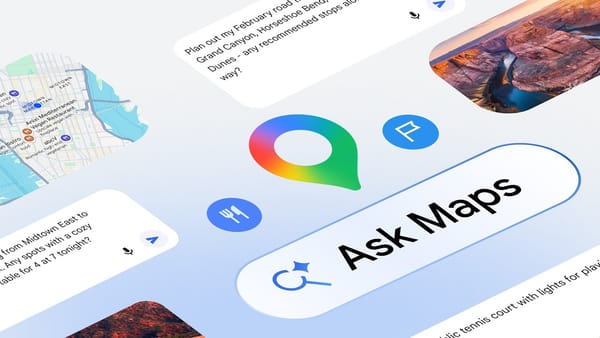
Conversational Search vs. Traditional SEO: Why Ask Maps Changes Everything for Multi-Location Brands

Ask Maps rewards branch-specific proof, not domain authority. See how Paigent's Local AEO automation lifts walk-ins by up to 56% in 60 days across multi-location brands.
Conversational Search vs. Traditional SEO: Why Ask Maps Changes Everything for Multi-Location Brands
The majority of local searches now happen as conversations inside Google Maps — not typed queries on a search results page. That structural shift has made traditional SEO largely irrelevant for multi-location operators who need customers walking through their doors. Ask Maps doesn't rank pages. It cites businesses with branch-level proof. This post explains exactly what that means, and how Paigent is built to win it.
Key Takeaways
- Ask Maps surfaces only 3–8 businesses per query — making it the most competitive, highest-stakes local visibility channel for franchise networks and multi-location brands.
- 78% of local service brands are currently invisible to Ask Maps — meaning most multi-location operators are missing the channel that drives the majority of local intent (5W AI Visibility Index, 2026).
- Paigent generates 5–10 optimized pages per location — giving every branch the branch-specific proof it needs to qualify for Ask Maps answers, not just your flagship store.
- The six-step automated workflow requires no marketing team — Paigent handles brand setup, location onboarding, AI topic identification, content generation, and publishing entirely on autopilot.
- Fast deployment at scale: 8 salons were deployed live in a single week — demonstrating that multi-location rollout doesn't have to mean months of content planning.
- 14-day free trial, no credit card required, no contracts — so you can verify Ask Maps visibility gains before committing to anything.
Why Traditional SEO Falls Short for Local AI Search
Traditional SEO was built for a different search paradigm. You optimized a page, earned backlinks, targeted keywords, and waited for a blue-link ranking. That model assumed a user was scrolling a results page and choosing manually.
Ask Maps doesn't work that way.
When someone says "best mortgage lender near me" or "dental clinic open Saturday in [neighborhood]" inside Google Maps, the AI answer engine doesn't scan your domain authority. It looks for branch-level proof — evidence that this specific location, in this specific neighborhood, has depth and credibility around the query.
That's the fundamental mismatch. Traditional SEO builds brand-level authority. Ask Maps rewards location-specific authority. A restaurant group with 40 locations needs 40 independent authority profiles — not one well-optimized homepage.
The consequence is stark: according to the 5W AI Visibility Index (2026), 78% of local service brands are invisible to Ask Maps right now. Not because their brand is weak. Because their individual branches lack the neighborhood-specific content signals Ask Maps needs to cite them.
Backlinks don't fix this. Meta descriptions don't fix this. A new keyword strategy doesn't fix this. The only path to Ask Maps visibility is branch-specific proof at scale — which is precisely what Paigent was built to generate.
| Dimension | Traditional SEO | Ask Maps / Local AEO |
|---|---|---|
| Authority unit | Brand / domain | Individual branch location |
| Primary signal | Backlinks, keyword density | Branch-specific content, review language |
| Query type | Short keyword ("dentist Chicago") | Conversational ("dentist near me open Saturday") |
| Results shown | 10+ blue links | 3–8 cited businesses |
| Content volume needed | One optimized homepage | 5–10 pages per branch location |
| Who is invisible | Poorly optimized domains | 78% of local service brands (5W AI Visibility Index, 2026) |
How Conversational Search Queries Are Structurally Different
Understanding why Ask Maps behaves differently starts with the query itself.
Traditional SEO queries are short, transactional, and keyword-shaped: "dentist Chicago" or "best pizza." The user is browsing. The intent is loose.
Conversational search queries are longer, contextual, and intent-loaded: "Which dental clinic near me has same-day appointments and accepts new patients?" The user is deciding. The intent is immediate.
Ask Maps is engineered to answer that second type of query. It processes natural language, weighs contextual signals, and returns a short list — 3–8 businesses — that it's confident can actually satisfy the request. This is why Local AEO (Local Answer Engine Optimization) is a fundamentally different discipline than traditional SEO.
The ranking signals Ask Maps reads are not domain-level metrics. They are:
- Location-specific content that addresses the exact services, specialities, and context of that branch
- Review language that captures real, neighborhood-specific customer voice
- Profile completeness at the individual branch level, not the brand level
Multi-location operators who treat all 40 branches as variations of one brand profile lose this game by default. Every location needs its own content authority — and building that manually across dozens of branches is operationally impossible without automation.
The Ask Maps Visibility Gap: What 78% of Brands Are Missing
The 5W AI Visibility Index (2026) found that 78% of local service brands are invisible to Ask Maps. That's not a minor ranking gap. That's a structural absence from the channel that now drives the majority of local search intent.
Here's what invisibility looks like in practice: Ask Maps processes a conversational query, scans branch-level proof across competing businesses, and your locations simply don't appear. The 3–8 spots go to competitors who have neighborhood-specific content, structured review signals, and complete local profiles.
The visibility gap exists because most multi-location brands have solved the wrong problem. They've invested in brand-level SEO, national content strategies, and centralized marketing — tools designed for traditional search. None of that infrastructure creates the branch-specific proof that Ask Maps reads.
The businesses closing this gap are doing something structurally different. They're generating location-specific content at scale, collecting voice and text reviews that capture real customer language, and maintaining individual branch profiles as living, authoritative documents.
The measurable outcomes from Paigent deployments reflect that shift directly:
- Dental practices: +56% walk-in increase in 60 days
- Salon networks: +47% walk-ins in 90 days
- Restaurant groups: +34% walk-ins in 90 days
- Cross-vertical average: +40% walk-in increase by Day 90
These are per-location results — which is exactly the unit of measurement that matters for multi-location operators. The dental clinic figure corresponds to an estimated $150,000–$250,000 in additional annual revenue per location from new patients, based on Paigent's deployment data. The salon vertical shows $50,000–$100,000 per salon annually. These figures are drawn directly from Paigent's documented deployment outcomes, not projected estimates.
How Paigent Delivers Ask Maps Authority: The Six-Step Workflow
Paigent's six-step automated workflow moves each of your locations from invisible to Ask Maps-visible without requiring a content team or manual production effort.
- Set up brand voice and business model. Define your tone, services, and core brand parameters once. Every piece of content Paigent generates inherits this — keeping you always on-brand across every branch and every topic.
- Add your locations — 10, 50, or 150+. Paigent is built for brands with three or more locations. Input your branch list and the system treats each location as an independent authority-building project.
- AI identifies what makes each location unique. Paigent's AI surfaces neighborhood-specific signals — local context, service variations, community touchpoints — that differentiate branch from branch. No two locations get identical content.
- AI suggests branch-specific content topics. Rather than generating generic "services we offer" pages, Paigent proposes topics calibrated to what Ask Maps actually reads for that branch's query context. You review and approve.
- Select and generate content. Paigent produces 5–10 optimized pages per location — the volume Ask Maps needs to assess branch-level authority. Content is generated at scale across your entire portfolio simultaneously.
- Publish manually or activate auto-mode. Choose your control level. Auto-mode puts Local AEO on autopilot — content publishes, profiles update, and your branch visibility compounds over time without ongoing intervention.
Setup takes two weeks. The full workflow supports 77 languages for voice and text reviews, so every branch captures authentic customer language regardless of the communities it serves. All reviews require business owner approval before publishing — your brand voice stays protected even in a fully automated pipeline.
Addressing the Core Concern: Can Automation Really Win Local AI Search?
The hesitation most operators have is legitimate — and worth addressing directly. Automated content at scale can mean generic content at scale, and generic content is exactly what Ask Maps ignores.
Paigent's architecture is designed around this specific risk. The AI doesn't apply one template across all your locations. It identifies what makes each location unique before suggesting topics — neighborhood signals, service variations, local context. The result is location-specific content that reads as branch-authored, not brand-cloned.
To make this concrete: the review pipeline reinforces location specificity in a way that generic AI tools cannot replicate. Voice and text reviews collected in 77 languages capture authentic customer language at the branch level. Those reviews automatically inform content generation and update the profile in a unified system — meaning each location's authority compounds over time rather than stagnating at initial setup. Reviews are also auto-translated to English, French, and Mandarin, and auto-formatted for Google or Instagram, with every review requiring business owner approval before it goes live.
The operational proof is in the deployment data: 8 salons went live in a single week. The multi-location rollout problem is solved at the infrastructure level — not by adding headcount or content staff, but by building the automation layer that makes manual production unnecessary.
There are no contracts. You can cancel anytime. The 14-day free trial requires no credit card. The risk profile is calibrated for operators who want to validate results before committing — which is exactly what Paigent expects you to do.
Why Choose Paigent
Paigent is built specifically for Ask Maps and Local AEO ranking — not repurposed as a general-purpose SEO tool with AI features added later. That distinction matters more than any other feature claim.
Branch-specific proof at scale so every location wins its local AI search. Not your brand. Not your flagship. Every location — independently ranked, independently cited by Ask Maps — because each branch gets 5–10 optimized pages built around its own neighborhood signals.
Multi-location rollout without a marketing team. The six-step automated workflow handles brand voice configuration, location onboarding, AI topic identification, content generation, and profile updates without requiring content staff. Eight salons deployed live in a single week is what that looks like in practice.
A unified system where reviews, content, and profile work together. Voice and text reviews collected in 77 languages automatically inform content generation, which automatically updates the branch profile — all in one pipeline. Competitors offering separate review tools, separate content tools, and separate profile management cannot produce the compounding authority effect that comes from a unified system.
Always on-brand — consistent voice across every branch and every topic. Brand parameters set once in Step 1 propagate to every piece of content generated across every location. Consistency at scale is a system output, not a manual QA step.
Live in two weeks, with a 14-day free trial, no credit card required, no contracts. Start your free trial at Paigent and see which of your locations can reach Ask Maps positions #1–3 before your competitors do.
Multi-location operators — mortgage lenders, restaurant groups, real estate franchises, dental practices — compete in a search environment where 78% of their peers are invisible. Paigent is the automation layer that closes that gap, location by location, on autopilot.
---
If your locations are among the 78% invisible to Ask Maps today, the path forward is branch-specific proof at scale — not a new keyword strategy. Start your 14-day free trial at Paigent and see which of your locations can reach Ask Maps positions #1–3 before your competitors do.
Frequently Asked Questions
How is Ask Maps optimization different from traditional local SEO for multi-location businesses?
Traditional local SEO targets domain-level authority and keyword rankings on search results pages. Ask Maps optimization targets branch-level proof signals — location-specific content, neighborhood-specific review language, and complete individual branch profiles — that AI answer engines read when processing conversational queries. Ask Maps surfaces only 3–8 businesses per query, making branch-level authority the deciding factor rather than brand-level domain metrics.
Why do franchise networks and multi-location brands need branch-specific content rather than one central brand strategy?
Ask Maps evaluates each location independently when answering a conversational query like "best mortgage lender near me." A brand-level content strategy creates one authority profile shared across all branches. Paigent generates 5–10 optimized pages per location so each branch has independent Ask Maps authority — the same reason a salon network saw +47% walk-ins in 90 days rather than a brand-wide average lift.
What does Paigent's six-step automated workflow actually produce for each location?
The workflow moves from brand voice setup and location onboarding through AI-identified neighborhood-specific signals to branch-specific content topic suggestions, content generation, and publishing — either manual or auto-mode. Each location receives 5–10 optimized pages. The system collects voice and text reviews in 77 languages, auto-generates Instagram posts, and updates each branch profile in a unified pipeline without requiring a marketing team. All reviews require business owner approval before publishing.
How quickly can a multi-location brand deploy Paigent across its full location network?
Setup takes approximately two weeks, with full-network rollout demonstrably fast at scale — 8 salons were deployed live in a single week. Paigent is built for brands with three or more locations and supports networks of 10, 50, or 150+ branches simultaneously. The 14-day free trial with no credit card required means operators can validate Ask Maps visibility gains before committing. There are no contracts and you can cancel anytime.
What makes Paigent's content different from generic AI-generated content that Ask Maps would ignore?
Paigent's AI first identifies what makes each location unique — neighborhood context, service variations, local signals — before suggesting content topics. Combined with voice and text reviews collected in 77 languages that automatically inform content generation in a unified system, each branch builds an independently authentic authority profile. Reviews are also auto-translated to English, French, and Mandarin and formatted for Google or Instagram, with business owner approval required before anything publishes.
Does Paigent work for industries beyond restaurants and salons?
Paigent is designed for any multi-location operator competing for local AI search visibility. Verified verticals include mortgage lenders, restaurant groups, real estate franchises, retail chains, and dental practices. Documented deployment outcomes include a +56% walk-in increase at a dental practice in 60 days and a +34% increase at a restaurant group in 90 days. The platform applies to any industry where local intent queries drive foot traffic or appointment bookings.
What happens to brand consistency when content is generated at scale across 150+ locations?
Brand voice and business model parameters are configured once in Step 1 of Paigent's workflow and propagate to every piece of content generated across every location. Each branch gets neighborhood-specific, branch-authored content that is simultaneously always on-brand — consistent voice across every branch and topic is a core system output, not a manual QA step, because brand parameters are baked into the generation pipeline from the start.